

It’s when the universe needs preservation; Lord Vishnu himself comes! Yes, Lord Vishnu, सर्वव्यापक, सर्वत्र विद्यमान, the protector of the universe, returns to Earth in times of adversity. He re-establishes the equilibrium between the good and the bad and showers bliss everywhere around. It’s also said that he has also reincarnated multiple times on earth and is believed to appear one more final time before this world ends.
Proceeding further, here in this blog, we will get to know more about Lord Vishnu Ji:
Known by the names Narayana, Hari, Govinda, and Trimurti, गोविन्द, माधव, the names reflect the multifaceted nature of Lord Vishnu. Worshipping and praying to him provides a person with eternal grace and happiness that lasts beyond births.
Narayana means that he resides in every being, person, water, and primeval man. Nar means living beings and water, and ayana means resting place, refuge, and shelter. He is called Govinda because he is the protector of cows and senses. Trimurti, because he is the triple deity of supreme divinity, which includes Brahma and Shiva. Therefore, all the names carry different meanings and importance.
Why does humanity always seek protection, peace, and stability?
The very moment when a child is born, the first and foremost need becomes one’s safety and protection. Just like ancient humans or animals seek shelter from the wild animals, similarly, we also look for security in every aspect of our lives, be it finance, health, or emotional assurance. This is our soul’s core need. The fluctuations like gain or loss, joy, sorrow, love, and betrayal are the cycles of our life that keep on shifting and need balance every time. So, to uncover peace there, we connect to the divine, which is itself Lord Vishnu, the supreme, the higher deity.

Having blue skin and the cosmic and metaphysical nature, the blue hue showcases the infinite expanse of the sky, showing that Lord Vishnu presides everywhere. He resides in the milky waters of the Vaikunth on a bed made of the coils of the thousand-hooded great serpents. Goddess Lakshmi is his consort who attends upon him.
Vishnu Ji as The Preserver in the Hindu Trinity (Brahma, Vishnu, Mahesh)

He is called the Trinity: Brahma, Vishnu, and Mahesh (Shiva)
Brahma means the creator of the universe, who gives life, ideas, and beginnings. Shiva, Mahesh called the destroyer or the transformer of things or creation. The one who dissolves everything that is no longer needed. Vishnu is the preserver, who maintains harmony, order, and balance in the Universe.
The divine symbols of Lord Vishnu ji as a preserver:
- Shankha—which produces the sound of ‘Om’ that symbolizes preservation of the universe.
- Padma—Lotus, represents unity and continuity amidst life struggles.
- Sudarshan Chakra—that destroys negativity and protects dharma.
- Gade—Called as mace, rod, is a symbol of strength and protection for devotees.
The Avatars of Lord Vishnu as Preserver
- Lord Rama
- Lord Krishna
- Lord Narsimha
About Lord Vishnu Yantra
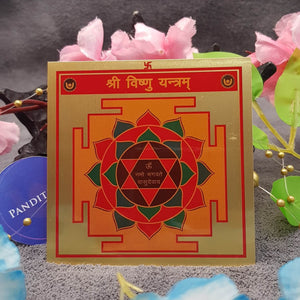
Ever wondered if you can get a sacred device that carries Lord Vishnu’s divine energy? Yes, you can attain the blessings of lifetime protection, preservation, harmony, and prosperity in a powerful cosmic tool now, where geometrical vibrations are etched. It’s the Shri Vishnu Yantra, which becomes a cosmic shield of a person that surrounds a devotee with divine vibrations and wards off the negativity forever.
The Sacred Geometry of the Yantra
a. The Gates, T-shaped extensions:
The yantra has four gates, called the cosmic boundary, which protect the energy of the yantra. These gates are meant for entry points of the divine energy and also to keep the negative forces away.
b. Lotus Petals:
The lotus petals on the yantra symbolize purity, divine creation, and spiritual unfolding.
c. The interlocking triangles:
The upward and downward triangles in the yantra showcase the divine masculine and feminine energies. This balance ensures cosmic stability, an aspect of Vishnu’s role as the Preserver of Dharma.
d. Central Bindu
The center of the yantra, the bindu, is the source of divine consciousness, where the sacred energy of Lord Vishnu flows.
e. The Mantra
“ॐ नमो भगवते वासुदेवाय”
The mantra is also encrypted on the yantra, which invokes protection, power, peace, and preservation. This mantra should be chanted to connect with Lord Vishnu’s divine energy.
So, in simple words, we can say that the yantra is like a blueprint of Lord Vishnu’s Ji safeguarding energy, and everyone should meditate on it and worship it to always stay balanced in life.
But how to worship the yantra correctly, adhering to all the puja norms with respect? We will throw light on every aspect of the यंत्र पूजन and यंत्र स्थापना here underneath; have a glance at:
श्री विष्णु यंत्र स्थापना विधि
Before installing the yantra, know that Thursday is the right day to install the yantra. Or you can also establish it on Ekadashis, Akshaya Tritiya, and Pushya Nakshatra. Get ideal advice regarding the शुभ तिथि, day, or time.
- Now take a holy morning bath and keep your mind positive and pure, as you have to install a holy yantra.
- Either place the yantra at the home’s sacred place, such as the Puja room, or wherever you will keep the yantra; the area should be neat, pure, and kept holy.
- The puja room should always be in the northeast corner of your home, as this part of a home is considered more sacred and spiritually potent.
- Keep the yantra on a wooden base in your home temple, or you can also keep a red cloth at the altar, then a brass plate, and then place the yantra there.
- To establish and energize the yantra now, offer it dhup, deep, and flowers.
- Chant the Vishnu mantra for at least 11, 21, or 108 times.
विष्णु यंत्र पूजा विधि
1. Setting Up the Sacred Space: Get up early on Thursday morning, the auspicious time of day for the puja. Sweep the area where the puja has to be done.
Make it holy by sprinkling Ganga Jal and rose water there. You can, as per your view, arrange fresh flowers and small diya lamps for the puja for decor. Now light up incense sticks for aromatic fragrance.
2. Invocation: Invoke the energy of Lord Vishnu by closing your eyes and visualizing Lord Vishnu sitting on the sheshnag. Chant the Mantra:
ॐ नमो भगवते वासुदेवाय
3. Upcharas: Upcharas means the offerings, which you should make. The offerings like tulsi leaves, flowers, fruits, and sweets, can be placed on the brass plate. Light the main puja diya.

4. Mantra Jaap: ॐ नमो भगवते वासुदेवाय. chant this mantra for 11,21 or 108 times. Or other mantras that you can chant are
ॐ नमो नारायणाय
ॐ श्रीं ह्रीं श्रीं विष्णवे नमः
ॐ श्रीविष्णु सहस्रनामस्तोत्राय नमः
ॐ ह्रीं वासुदेवाय नमः
ॐ नमो भगवते नारायणाय
5. Aarti: Aarti makes the puja lively and connects deeply to the divine. So, sing or recite Lord Vishnu Aarti. Wave the diya clockwise around the yantra, singing the aarti; it will give you goosebumps.
6. Concluding Rituals: Prasad and fruits should be distributed to the people in the puja. Sprinkle the Ganga Jal present in the puja on devotees in the puja
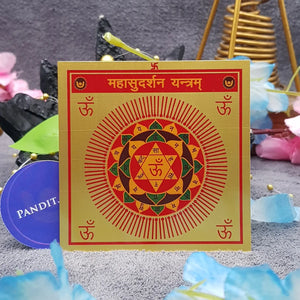
Pairing it up with the Sudarshan Yantra
The Combination of the Shri Vishnu Yantra and Shri Sudarshan Yantra will be a very powerful synergy. It helps destroy negativity, enemies, obstacles, and the effect of black magic.

Lord Vishnu Yantra: Helps build protective energy and maintains harmony in life.
Sudarshan Yantra: Acts as a shield against harmful sources, ensuring that the negative energies cannot affect you.
So, both these yantras should be combined and must be worshipped for receiving sacred blessings.
Final Thoughts
Hence, we have now got to know about Shri Vishnu Yantra and how it can help maintain harmony and balance in life. So, sit calmly and visualize the energy of the yantra to receive the divine Lord Ji’s blessings!
ॐ नमो नारायणाय नमः